-
Share this page
Phyllis Beddington-Wiener Research Chair
We are pleased to announce that Professor Harald Wydra from the University of Cambridge will be joining us in March and April 2026. The programme, coordinated by Professor François Foret, will include lectures, open courses, and research seminars covering topics aligned with Professor Wydra’s areas of expertise.
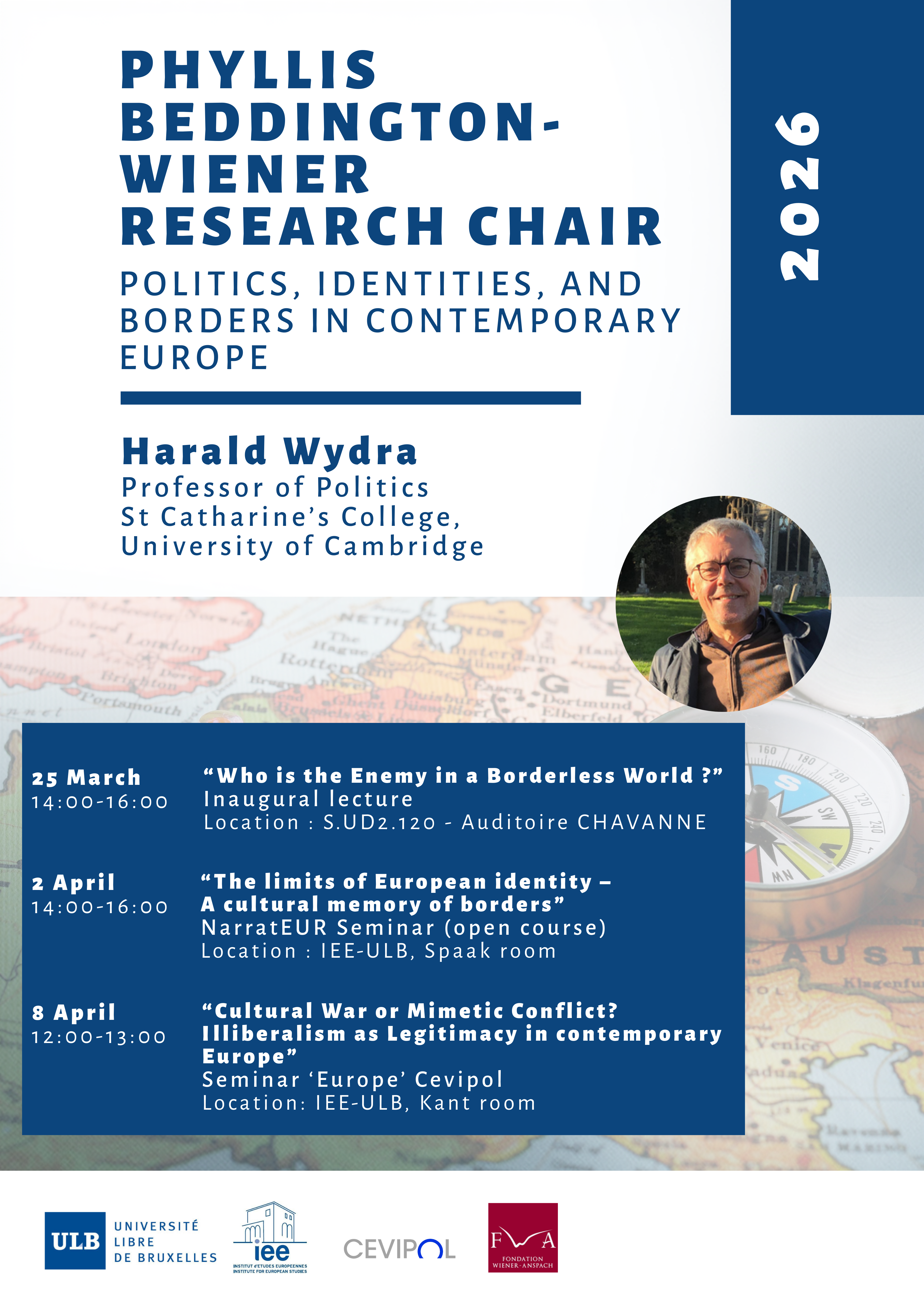
25 March, 14:00-16:00: "Who is the Enemy in a Borderless World ?”
Inaugural lecture - S.UD2.120 - Auditoire CHAVANNE
(Open to the public without registration)
Although the international liberal order sought to outlaw warfare and violence, various front lines have been internalised and thus made enemies invisible and ubiquitous. Increasingly, enemies are not political entities, but they are morally disqualified as fanatic and fundamentalist. They are de-humanized, put ‘outside’ the frame of civilization, and thus removed from any possible dialogue. And yet, enemies are our existential reflections, the shaping of ourselves, the mirror image of our own fears. When liberal states declared to lead a war of shadows anywhere in the world, they succumbed to the logic imposed by insurgents and terrorists. If the goals of warfare remain undefined, can violence be contained or only lead to more sacrifice? Can states maintain the moral high ground of fighting “bad” violence with their “good” violence? Is it possible to remain human when facing an invisible enemy in a borderless world?Open
2 April, 14:00-16:00 : “The limits of European identity – A cultural memory of borders”
Part of the NarratEUR 2026 seminar - IEE-ULB, Spaak room
Register hereThe promise to move towards an ever-closer union of the peoples of Europe is intriguing but strangely undefined. This paper explores hopes to expand the frontiers of Europe with a view to how the political psychology of borders has been shaped by cultural memory. The impenetrable frontier of the Iron Curtain was a key condition for opening borders and spaces inside the European Community. Political integration transcended borders but also met significant resistance, including Brexit or so-called right-wing populism. Today, intentions to expand eastwards advance by a contradictory movement. The EU external borders are closing, whilst prospective enlargement requires expanding frontiers into post-imperial spaces with strong national identity but a cultural memory of fear for survival, encirclement, and existential insecurity. Can the political will for EU enlargement be reconciled with liminal fluidity, fragile borders, and opening front lines? Can a post-sovereign Europe create moral closeness around a sacred core without maintaining the moral distance from outsiders? Can there be a European identity without limits?
8 April, 12:00-13:00: “Cultural War or Mimetic Conflict? Illiberalism as Legitimacy in contemporary Europe”
Seminar ‘Europe’ Cevipol - IEE-ULB, Kant room
(Open to the public without registration)
Conventional wisdom sees illiberal politics in East-central Europe as an illegitimate rejection of liberal democracy. What appears as a cultural war in rejection of western modernity and its attendant values and norms should be more accurately described as a process of legitimacy-formation in a region where collective identities are liminal and have largely been constructed in mimetic conflicts with western models. This paper explores three theses on cultural sources of the polarisation around the nationalist and illiberal turns in Poland and Hungary. First, the long-standing non-congruity of state borders with national consciousness created a psychology of fear and encirclement. Borders and meanings of collective national identity in the region have traditionally been liminal, weak, and porous. Second, the populist turn seeks a model of sovereign autonomy, which only in appearance is anti-Western. It is closer to a mimetic catching up, seeking sovereignty within domestic narratives, myths, and symbols, not as a poisoned gift by the secularised western Europe. Third, the nationalist turn in some Central Europe countries testifies not so much to a resentment of a technocratic-globalist European centre but rather to an unrequited love of not being accepted as equals.
About Professor Wydra
Harald Wydra is Professor of Politics and Holden Fellow in Politics at St Catharine’s College (University of Cambridge).
After studies of history and political science at the Universities of Regensburg and Salamanca, he took a PhD in Social and Political Sciences from the European University Institute in Florence. Before coming to Cambridge in 2003 he taught Political Science at the University of Regensburg. He held visiting fellowships at the EHESS in Paris and the Australian National University in Canberra. He was Visiting Professor at the Université Paris Ouest Nanterre La Défense, the Cultural Institute at the University of Wrocław, and LUISS University in Rome. He is a founding editor of the academic journal International Political Anthropology.
Read more about Prof Wydra's research and publications