-
Share this page
IDEAS 2026 : New paths towards prosperity in the European Union - Rethinking Governance, Integration and Collective Well-Being.
The biennial Interdisciplinary conference on European Advanced Studies (IDEAS) is a three-day scientific event organized by the Institut d’études européennes of the Université libre de Bruxelles (IEE-ULB) in collaboration with the Brussels School of Governance of the Vrije Universiteit Brussel (BSoG-VUB) and the Politics and International Studies Department at the University of Warwick (PaIS-UoW).
The IDEAS26 edition is co-organised with the Jean Monnet Network PROSPER. The conference will take place in Brussels, on May 27-29, 2026, and it will focus on New paths towards prosperity in the European Union – Rethinking Governance, Integration and Collective Well-Being.
Building on the Call for Papers launched in November, the IDEAS 2026 conference programme is largely composed of contributions by researchers whose papers were selected through the Scientific Committee’s evaluation process.
View the IDEAS 2026 Programme
Public access notice:
Please note that only the PROSPER Keynote and the PROSPER Policy Panel are open to the public. Registration is required to attend these sessions.
Highlights of the conference
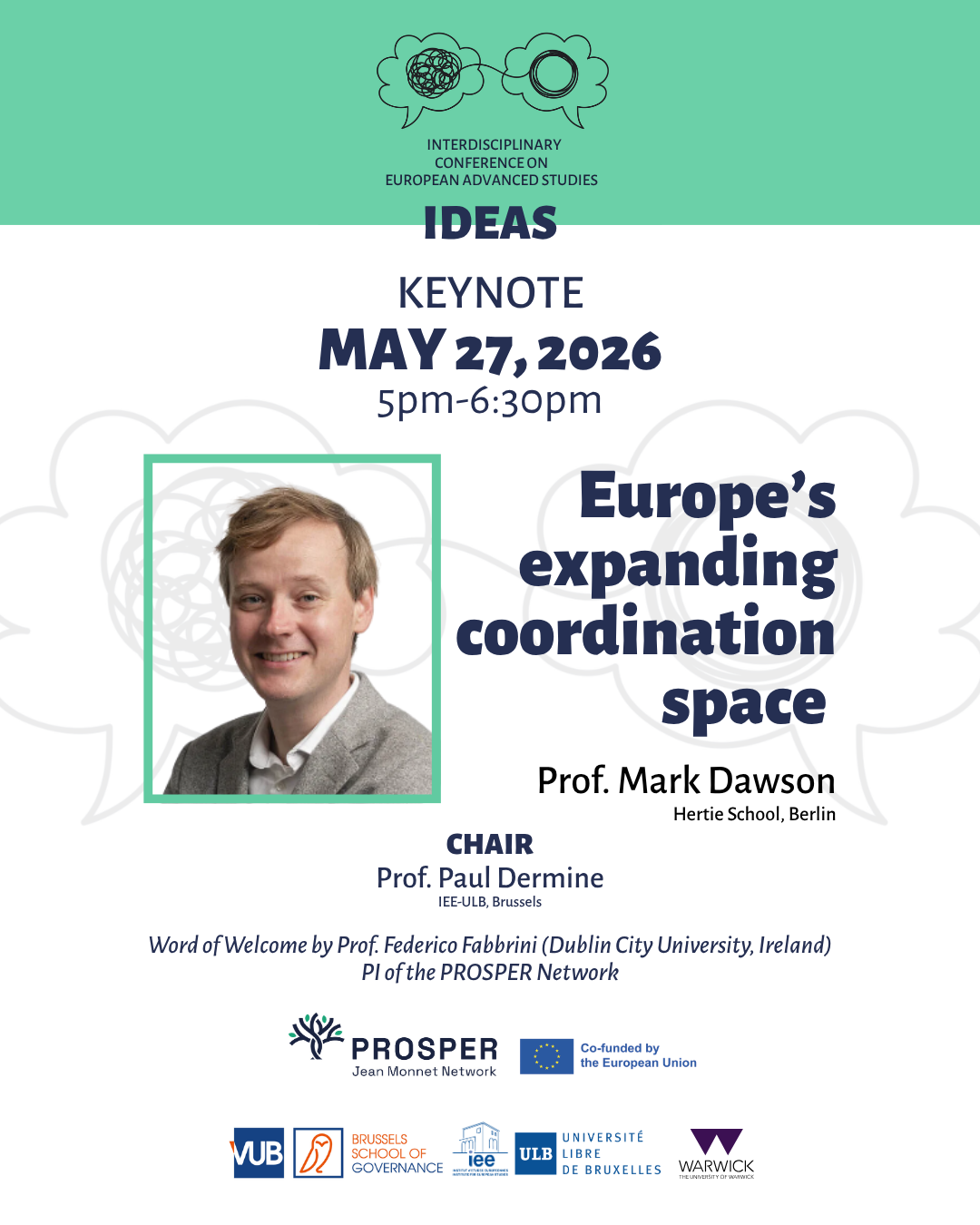
27 May, 17:00-18:30: "Europe’s expanding coordination space"
Keynote - Prof. Mark Dawson (Hertie School)
Chair: Prof. Paul Dermine (IEE-ULB)Word of Welcome by Prof. Federico Fabbrini (Dublin City University, Ireland), PI of the PROSPER Network
The European Union has been forged as a community of law. As once put by Weiler, law has been both the object and agent of integration i.e. both the vehicle through which the EU has been built and the end goal of integration itself. Yet, law is increasingly being displaced and marginalized in European integration. Not only is the EU of the 2020s increasingly built through resources rather than law but law - as a de-politicised medium of governance - struggles to articulate the range of distributive, moral and social conflicts driving EU policy-making. This lecture will explore the rise of the world of policy coordination as an alternative to the legal world, interacting with it but also supplanting it in key fields of EU governance. This coordination world carries different governing features and institutions, different capacities yet also poses different constitutional and legitimacy challenges when compared to the legal world. Where does this new world leave EU lawyers? A key role may be not to resist the rise of policy coordination but to infuse it with better elements of the legal world - namely its social and constitutional safeguards - while leaving behind its pathologies (an undemocratic and overly homogenizing vision of governance).
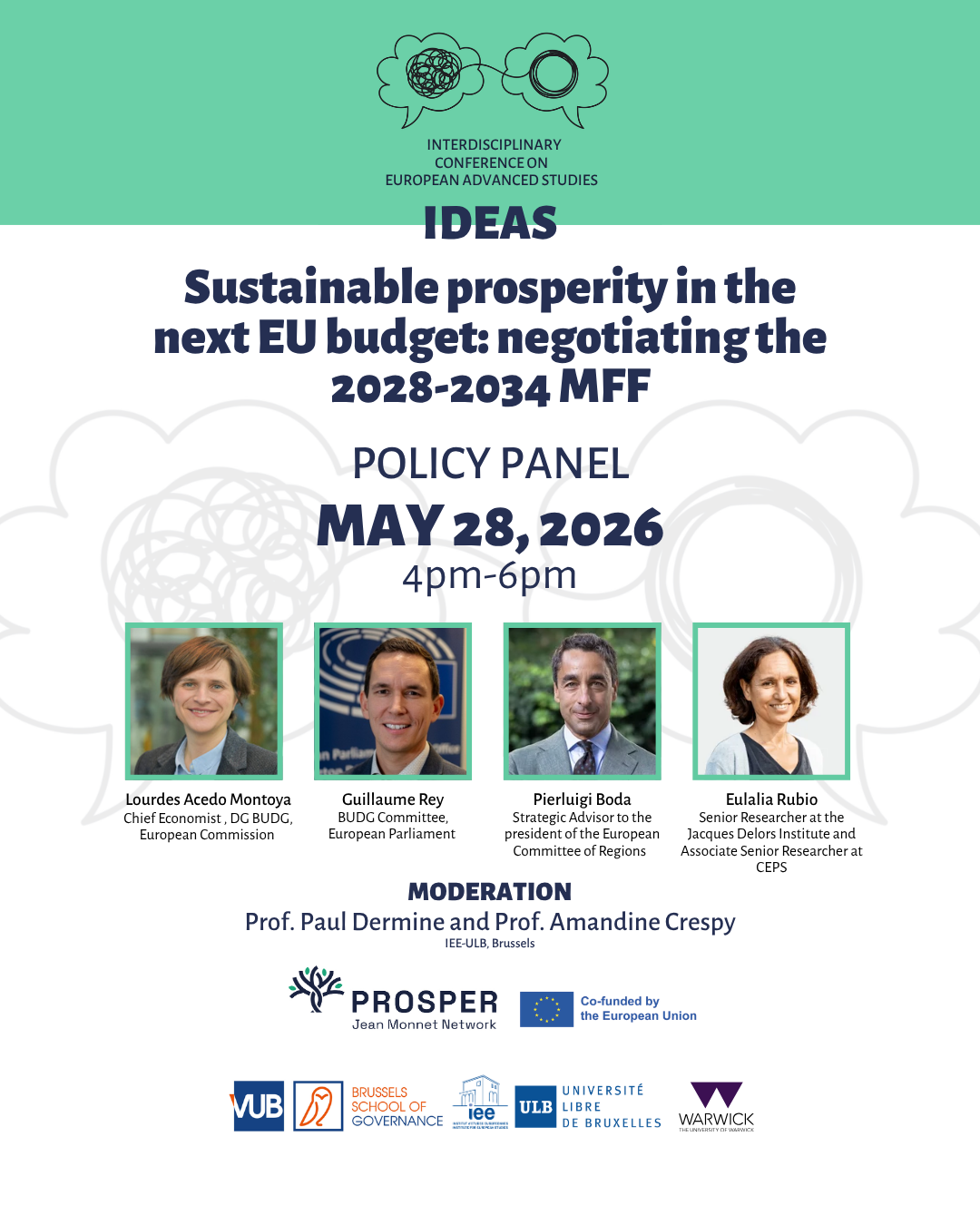
28 May, 16:00-18:00: "Sustainable prosperity in the next EU budget: negotiating the 2028-2034 MFF"
Policy Panel
With Lourdes Acedo Montoya (Chief Economist , DG BUDG, European Commission), Guillaume Rey (BUDG Committee, European Parliament), Pierluigi Boda (Strategic Advisor to the president of the European Committee of Régions) and Eulalia Rubio (Senior Researcher at the Jacques Delors Institute and Associate Senior Researcher at CEPS)Moderation: Prof. Amandine Crespy and Prof. Paul Dermine (IEE-ULB)
Over the past decade, the COVID-19 pandemic and the European Green Deal have led Europeans to redefine what prosperity means in the 21st century. The last EU multiannual financial framework was shaped by the need to support decarbonize our economy and make European societies more cohesive and resilient.The EU institutions have recently started negotiating their next multiannual financial framework, which will cover the 2028-2034 period. The proposals tabled by the Commission last July are bold, and include, among others, a reorientation of the key financial priorities of the Union, a deep overhaul of the existing budgetary programs, greater flexibility, a new permanent borrowing capacity, and a novel governance template directly inspired from the experience of the recovery plan NGEU. To evoke the ongoing negotiations, which are set to have a lasting impact on the future of the EU budget and of EU public finances more generally, this panel features officials from the European Commission, the European Parliament and the European Committee of Regions, and a representative from a major EU think-tank. The focus will, among others, be on the following questions: What understanding of prosperity should underlie the next MFF, and can we escape the trade-off between competitiveness, sustainability, and security? What should be the policy priorities of the EU for 2028-34, and how should they be reflected in budgetary terms? How should the governance of the EU budget evolve? How will the next EU budget reshape relations between the EU institutions and the Member States in terms of autonomy, coordination, and shared objectives?